






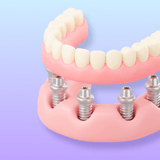
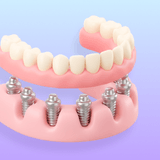
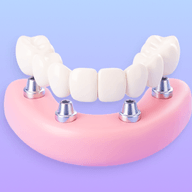
More implants can spread out the support
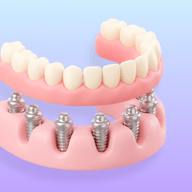
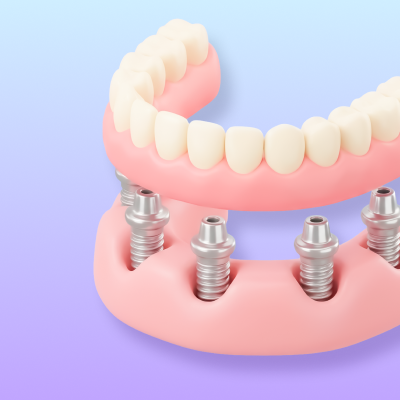
All-on-4 supports the bridge at four points. All-on-6 adds two possible support points, but they only help when there is good bone and a useful place for them.
Full-arch planning guide
Comparing All-on-4 and All-on-6 is about more than counting four implants versus six. This guide explains what can change in the support, bridge, and treatment stages—and what to prepare if you are considering an evaluation in Mexico City.


Both can support a fixed full-arch bridge, but All-on-6 is not simply All-on-4 with two extras. The support pattern, how far the bridge extends, and the maintenance it needs can change too.
All-on-4 supports the bridge at four points. All-on-6 adds two possible support points, but they only help when there is good bone and a useful place for them.
With All-on-4, the back implants are often angled to use available bone and shorten the part of the bridge without direct support. Six implants may give the team more room to spread them out when anatomy allows.
Your proposal should explain whether the bridge is one piece or divided into sections, what you receive at the temporary and final stages, and what options you would have if an implant develops a problem.
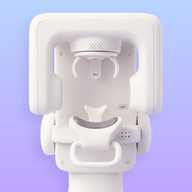
A CBCT scan, X-rays, and your health history help the team see where implants could go, whether grafting may be needed, and what timing is realistic before you finalize a plan or travel dates.
The number is only the starting point. What is worth comparing is where each implant would sit, how the bridge would be made, what options remain if one implant has a problem, and how the full set is cleaned. The name does not tell the whole story. The layout and bridge design are what reveal the real difference.
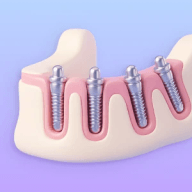
A fixed full-arch bridge is supported by four well-placed implants. The back implants are often angled to use available bone and extend support farther toward the rear.
The back implants are often angled
That angle can make better use of the bone and shorten the unsupported end of the bridge. It does not mean every case avoids grafting.
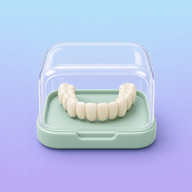
The bridge commonly works as one unit
Four well-placed implants can support a one-piece full-arch bridge. Your plan should explain what would happen if one of those supports develops a problem.
Helpful questions to ask
Ask where the four implants would go, how much bridge extends behind the last support, whether it will be one piece, and what options remain if an implant does not integrate or develops a problem later.
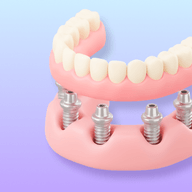
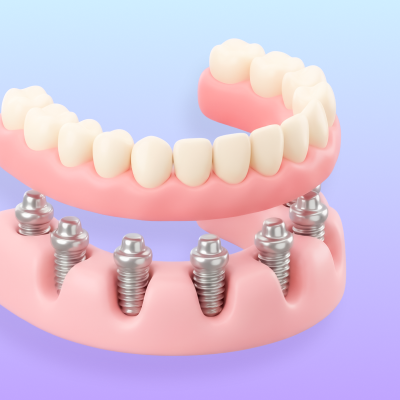
A fixed full-arch bridge is supported by six implants. When the bone offers six useful positions, support can be spread across more points and the bridge may be designed as one piece or in sections.
All six positions need to add value
Extra implants only help when they can be placed where they improve the bridge support. Reaching those positions may also require grafting or a larger surgery.
More options, more sites to maintain
Two additional implants may give the team more bridge-design options. They also add two areas that need careful cleaning and regular follow-up.
Helpful questions to ask
Ask what the two extra support points add in your case. They may spread support more widely, shorten the end of the bridge, allow a sectional design, or leave more options if one implant has a problem.
Answer three simple questions and we will help you organize what to bring, what to ask, and what to read next.
We do not save your answers. This guide also does not decide whether you are a candidate or how many implants you need.
Your planning checklist is ready.
Keep these points handy before your evaluation. They are conversation prompts, not a diagnosis or treatment plan.
Bring the original files
Include the CBCT DICOM file, its report if available, X-rays, and the date of each record; a screenshot alone may not be enough.
Ask which record is indicated
You do not need to arrange a scan on your own to start the conversation. Share what you already have and ask which imaging would be useful after review.
Compare scope line by line
Beyond what is included, ask why four or six implants are proposed, how they will be distributed, the planned cantilever, and whether the bridge will be one piece or segmented.
Request a stage-by-stage plan
Ask the proposal to separate surgery, provisional restoration, healing, final restoration, and follow-up—and explain what actually changes when four or six implants are used.
Talk through Mexico City before booking travel
Share tentative dates and ask what can be reviewed remotely, which imaging can be completed at hisonrisa, and how many visits may be needed before booking your trip.
Understand the timeline first
Even if travel is not part of your plans today, ask how the phases are spaced and what follow-up you would need. You will know what is involved if Mexico City becomes an option later.
An in-person evaluation and clinical review are what allow diagnosis, candidacy, implant number, and position to be discussed.
The team first considers the bridge you need, then the best places to support it. That is why the full layout matters more than choosing four or six in advance.
Your CBCT scan and X-rays help identify where four or six implants could provide useful support.
The team reviews how far back support reaches, whether any implants need to be angled, and how much bridge extends past the final support.
Your plan should explain what is confirmed before surgery, which temporary bridge you may receive, and what needs to happen before it can be placed.
Follow-up visits help fine-tune cleaning, comfort, and timing before the final bridge and its maintenance plan are prepared.
You can compare plans and start a conversation before deciding where to have treatment. If Mexico City becomes an option, your records and written quote help hisonrisa understand what has already been proposed and which imaging may still be needed.


You can begin the comparison before you travel or once you are in Mexico City. Either way, the first step is simply to share what you already have.
Share any scans, X-rays, or written quote you already have. If something needs updating, we can take new images at hisonrisa when you arrive. See how to plan dental care from outside Mexico before choosing final flights or dates.
Straightforward answers to help you understand the comparison before your evaluation.
No. Comparative studies show broadly similar survival overall, although some report differences in technical complications or bone-level changes. Six implants may broaden distribution, create prosthetic options, or provide alternatives if a complication occurs—but only when six useful sites exist and the design benefits from them. They also add connections and tissues to maintain.
Yes. The upper and lower arches have different anatomy, bone quality, limits, and forces. One may offer six useful positions while the other is treated with four strategic implants. Each arch needs its own review of distribution, cantilever, opposing teeth, and bridge design.
A CBCT shows bone volume and distribution in three dimensions, along with anatomy such as the maxillary sinuses and mandibular nerve. It helps assess whether four or six prosthetically useful sites exist, whether tilted placement may help, and what cantilever may remain. It does not confirm candidacy or the final plan by itself.
It should not be assumed. Some plans use a provisional restoration during an early phase and leave the final restoration until healing, fit, and other clinical criteria have been reviewed. The written proposal should explain which restoration is delivered at each stage and what conditions may change timing.
Besides separating surgery, provisional restoration, final restoration, and follow-up, it should explain why four or six implants are proposed, their distribution, planned cantilever, whether the bridge is one piece or segmented, and what happens if an implant does not integrate. It should also clarify possible grafting, maintenance, and exclusions.