





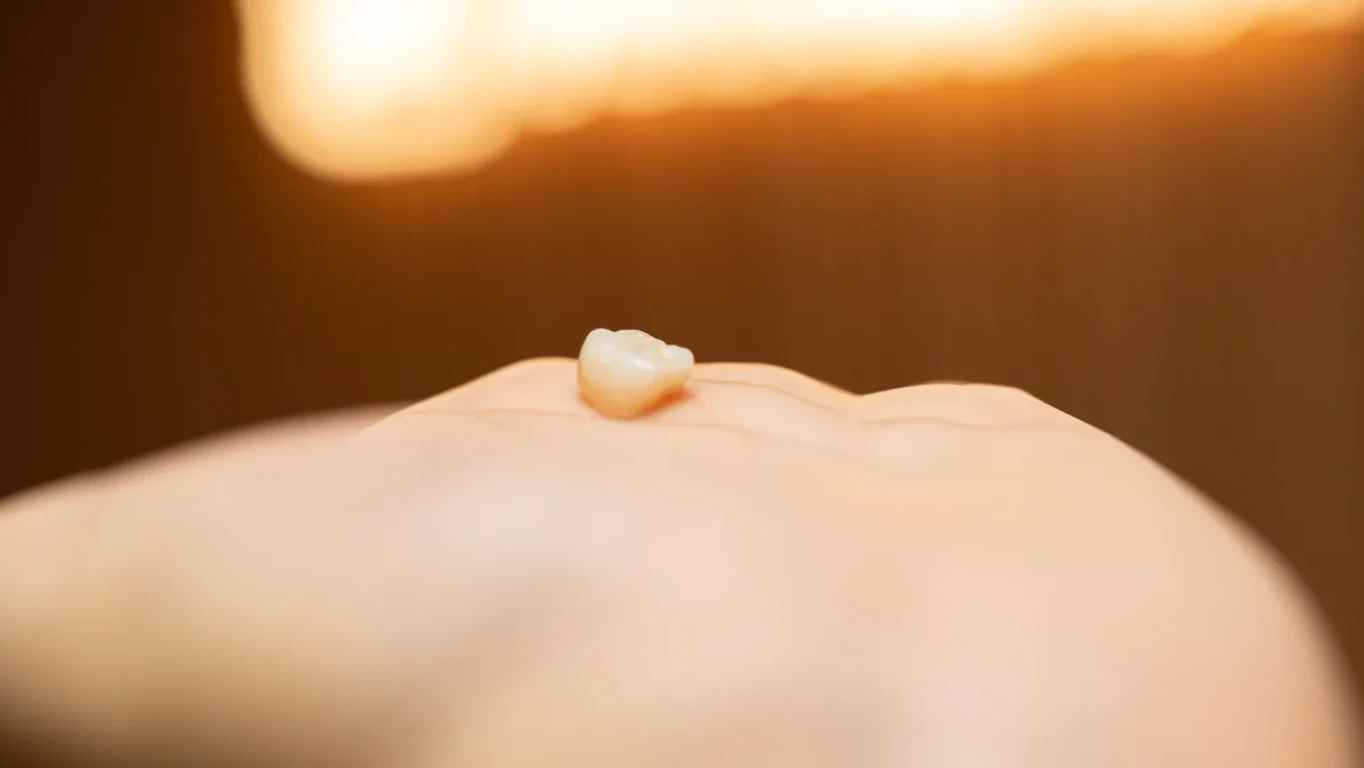
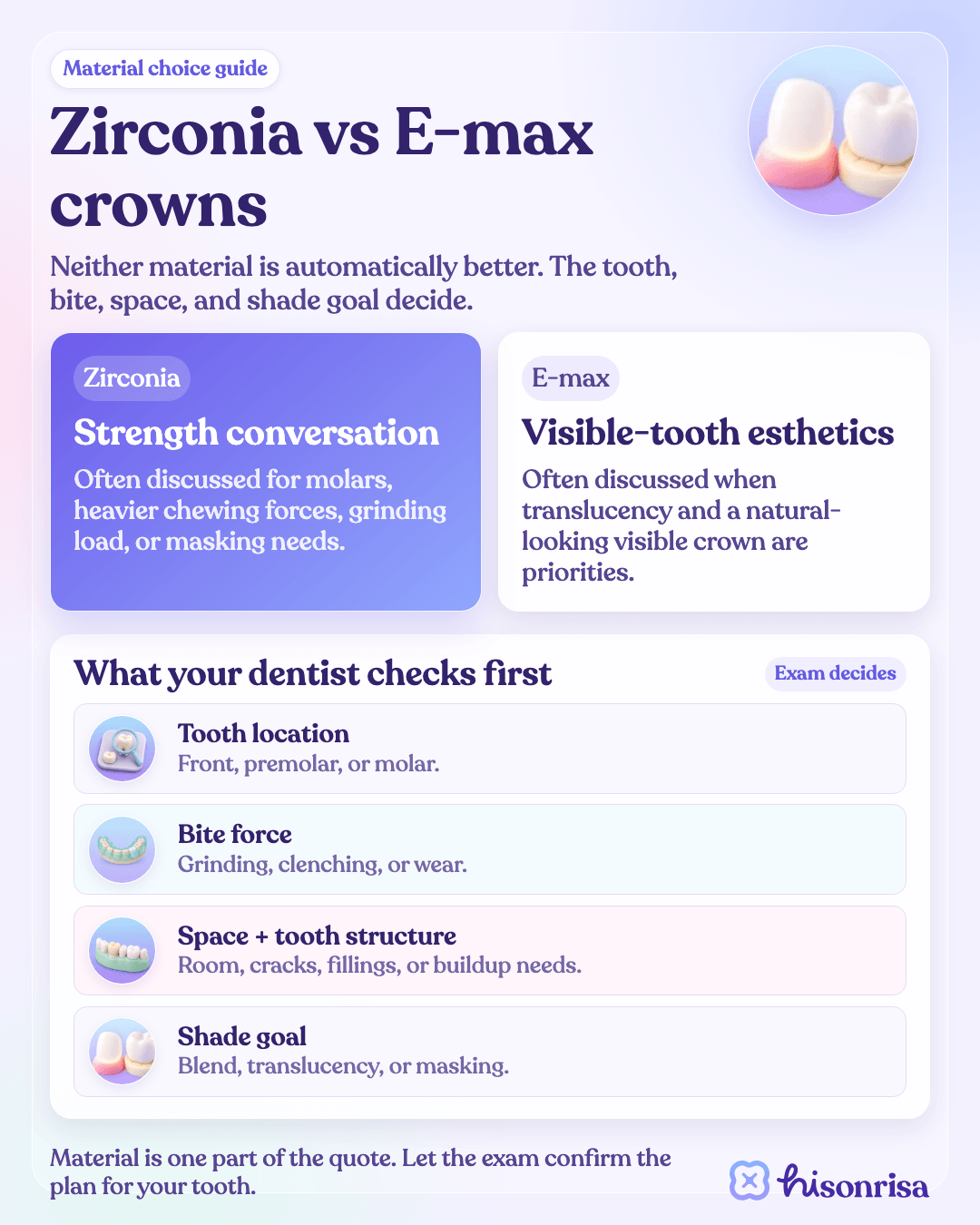
If you are comparing zirconia vs E-max crowns, you probably want a simple answer before you commit to treatment. The careful answer is this: neither material is automatically better. Zirconia often enters the conversation when strength, molars, high bite force, or grinding matter. E-max often enters the conversation when a visible tooth needs a natural-looking ceramic result. The right choice still depends on the tooth, your bite, the available space, the shade goal, and the dentist’s exam.
For an answer based on your actual tooth, start with a crown evaluation and material recommendation in Mexico City. A search result can help you ask better questions; it should not choose the crown material for you.
Quick comparison for zirconia vs E-max crowns
Use this as a quick conversation guide before the exam:
- Strength and bite load: Zirconia often enters the discussion when heavier chewing forces matter. E-max often enters the discussion when a selected single crown has esthetic priority.
- Appearance: Zirconia can look very good with careful shade planning and finishing. E-max is often valued for translucency and visible-tooth esthetics.
- Molars and back teeth: Zirconia is commonly discussed for molars and high-load areas. E-max may fit selected posterior cases, but bite and space still matter.
- Front teeth and visible teeth: Zirconia may help when strength or masking dark tooth structure matters. E-max is often considered for visible single crowns.
- Bruxism or clenching: Zirconia is often part of the discussion when grinding raises load concerns. E-max needs careful case selection when bite forces are high.
- Cost and quote scope: Material can affect the quote, but the diagnosis decides what else is needed for both options.
- Choosing before the exam: You can share a material preference, but the dentist should confirm whether it fits your tooth, bite, and plan.
What zirconia and E-max mean in plain English
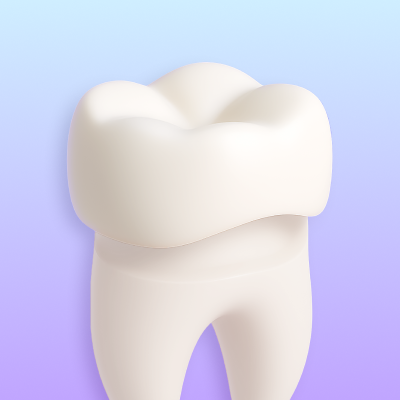
Zirconia and E-max are both ceramic crown options, but they are not interchangeable labels.
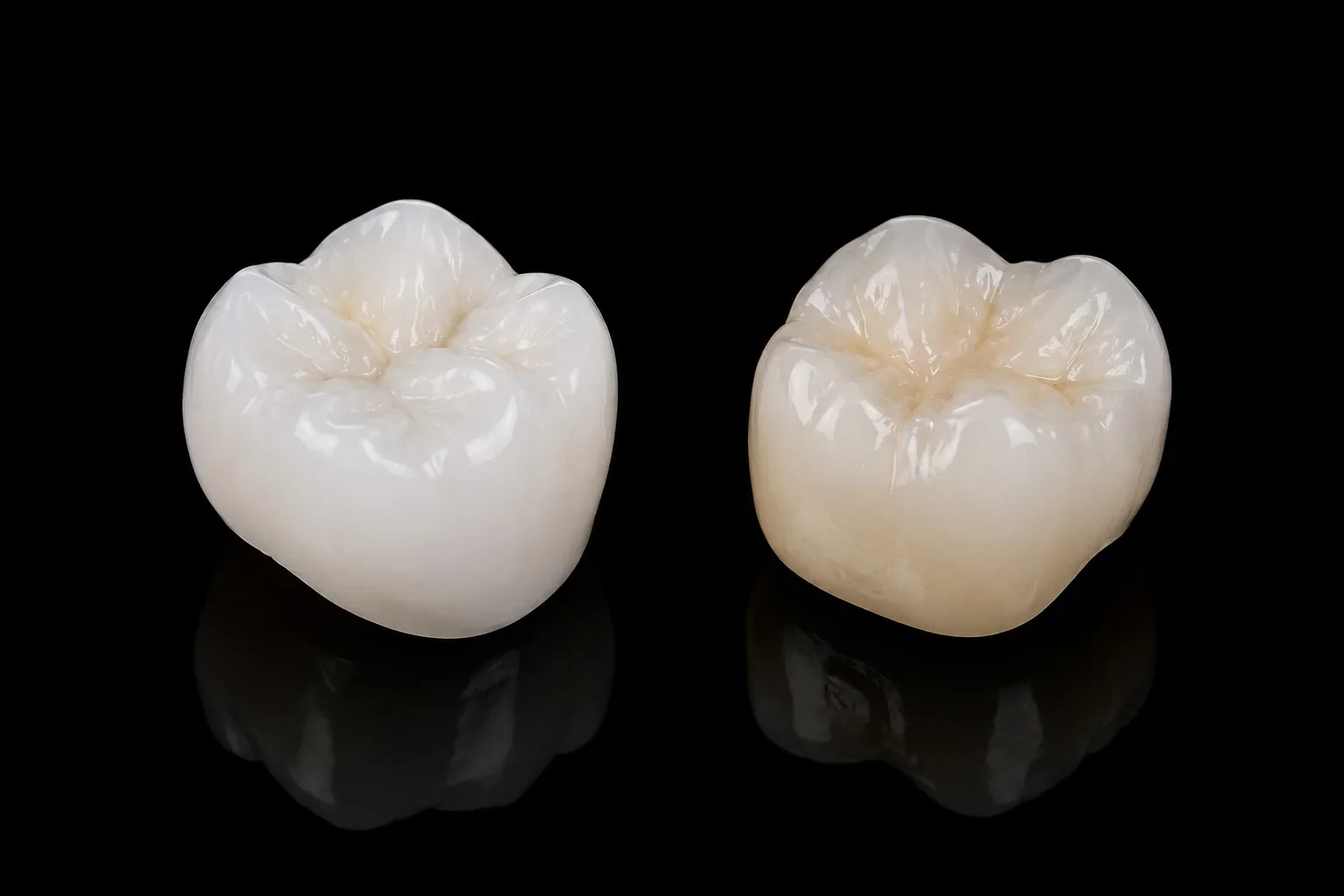
Zirconia is a strong dental ceramic. Patients usually hear about it for back teeth, molars, high-bite areas, or cases where fracture resistance matters. That does not make it the default for every back tooth. The dentist still has to look at the tooth foundation, bite, opposing teeth, available space, and esthetic goals.
E-max is the name patients commonly use for lithium disilicate glass-ceramic. It often comes up when a visible tooth needs a crown that blends naturally with nearby teeth. That does not make it automatic for every front tooth. A dark tooth underneath, a heavy bite, or a different restorative design can change the recommendation.
Patients also search for zirconia vs porcelain crowns. In everyday language, “porcelain” often means “tooth-colored crown.” Clinically, zirconia and E-max/lithium disilicate are different ceramic materials. If an old treatment note or quote says porcelain, ask which material it means.
When zirconia may make sense
Zirconia is often considered when a crown has to manage more force. That can include molars, patients who grind or clench, root-canal-treated teeth with less remaining tooth structure, or cases where the dentist wants a strength-focused ceramic option.
For a molar, chewing load matters. The crown also has to meet the opposing tooth without creating a bite problem. That is why zirconia may enter Mexico City crown planning when the patient has a strong bite, visible wear, or a tooth that needs more structural support.
Still, zirconia is not a shortcut around diagnosis. Space, cracks, old fillings, gumline position, shade goals, and the way the opposing tooth contacts the crown can all change the plan.
When E-max may make sense
E-max is often considered when the crown will show in the smile and the goal is a natural ceramic appearance. It can be especially relevant for selected single front teeth or premolars where the crown needs to blend with neighboring teeth.
The visual tooth matters, but it is not the only issue. A front tooth can still have a heavy bite. A tooth can be darker underneath than the patient expects. A visible crown may need to mask old restorations or match teeth that are not perfectly uniform. In those cases, the dentist may still recommend a different material or a modified plan.
Also, material choice is separate from workflow. This article is not saying E-max is milled in-house, that a specific machine is active, or that timing follows automatically from the material. Those details need to be confirmed during treatment planning.
What changes the recommendation
A good crown recommendation starts with diagnosis. The material is chosen after the dentist checks the tooth and the bite.
Key factors include:
- Tooth location: molars, premolars, and front teeth face different force and esthetic demands.
- Bite force: grinding, clenching, or worn teeth can change the risk discussion.
- Available space: the crown needs room for shape, strength, and appearance.
- Remaining tooth structure: cracks, decay, old fillings, root canal status, and buildup needs can affect the plan.
- Tooth color underneath: a dark foundation may need more masking.
- Neighboring teeth: a visible crown has to blend with what is already there.
- Treatment scope: one crown, several crowns, and a larger bite plan are different cases.
The better appointment question is not “Which material is superior?” It is: “Given this tooth and my bite, which material would you recommend, and what tradeoff are we choosing?”
Cost questions in Mexico City
Material can affect cost, but zirconia vs E-max should not become only a price decision. The crown fee is one part of the quote. Depending on the diagnosis, the tooth may also need a core buildup, post, root canal treatment, emergency care, or timing option that is separate from the crown material.
For current MXN pricing and what is included, use the current dental crown cost in Mexico City page instead of external averages. U.S. lab fees, insurance estimates, and competitor price tables do not explain what your diagnosis includes at hisonrisa.
If you are planning crowns on several teeth, the material decision also becomes a shade, bite, and sequence decision. A single visible crown and a group of visible crowns are not planned the same way. For that situation, review planning several dental crowns in Mexico City instead of using a single-tooth comparison as the whole plan.
A practical way to use this comparison
Use the comparison as a way to prepare for the appointment, not as a final decision.
If your main concern is a back tooth, strong bite, grinding, or heavier chewing forces, zirconia may be part of the recommendation. If your main concern is a visible single tooth and natural translucency, E-max may be part of the recommendation. Those are starting points, not rules.
Bring focused questions:
- What material fits this tooth and my bite?
- Do I have enough space for the material I prefer?
- Will the crown need to mask a dark tooth or blend with visible neighboring teeth?
- Does grinding or clenching change the recommendation?
- What is included in the quote, and what might be separate?
Those questions help the dentist explain the tradeoff clearly.
FAQs about zirconia and E-max crowns in Mexico City
Is zirconia or E-max stronger?
Zirconia is generally discussed as the higher-strength ceramic, especially when bite force and posterior teeth are major concerns. Strength is only one part of the decision. The dentist also has to consider appearance, space, bite, tooth structure, and the treatment plan.
Which crown looks more natural, zirconia or E-max?
E-max is often discussed for visible crowns because of its translucency and shade behavior. Modern zirconia can also look good in the right case. The result depends on the material, the tooth color underneath, the neighboring teeth, the lab work, and dentist review.
Is zirconia or E-max better for molars?
Zirconia is often considered for molars because chewing forces are higher in the back of the mouth. That does not mean every molar needs zirconia. The dentist still has to evaluate space, opposing teeth, grinding, and how much healthy tooth remains.
Is E-max better for front teeth?
E-max is often considered for visible single crowns when esthetics and translucency are priorities. It is not automatic. A dark tooth underneath, a heavy bite, or a different restorative design may change the recommendation.
Is E-max cheaper than zirconia?
Do not choose between E-max and zirconia from external averages. Material can affect the quote, but current hisonrisa pricing and what is included belong on the crown cost page. The diagnosis matters because buildup, post, root canal treatment, emergency care, or timing needs may be separate from the crown material.
Is zirconia the same as porcelain?
No. Patients often use “porcelain” broadly to mean a tooth-colored crown, but zirconia and E-max/lithium disilicate are different ceramic materials. If a quote or old treatment note says porcelain, ask which material it means.
Can I choose a crown material before the exam?
You can share a preference and ask about options, but the final material should be chosen after an exam, diagnosis, bite review, and treatment planning. A photo, price list, or search result cannot show everything the dentist needs to know.
If you want a recommendation for your specific tooth, schedule a diagnosis-based crown material recommendation at hisonrisa in Roma Sur.
This article is general dental information for dental crown material planning. It does not replace dental evaluation, diagnosis, imaging when needed, or review by a dentist.